Open positions in the Qiu lab
We currently have funding for 1 Ph.D. student (to start in fall 2027). Please see details in the following sections!
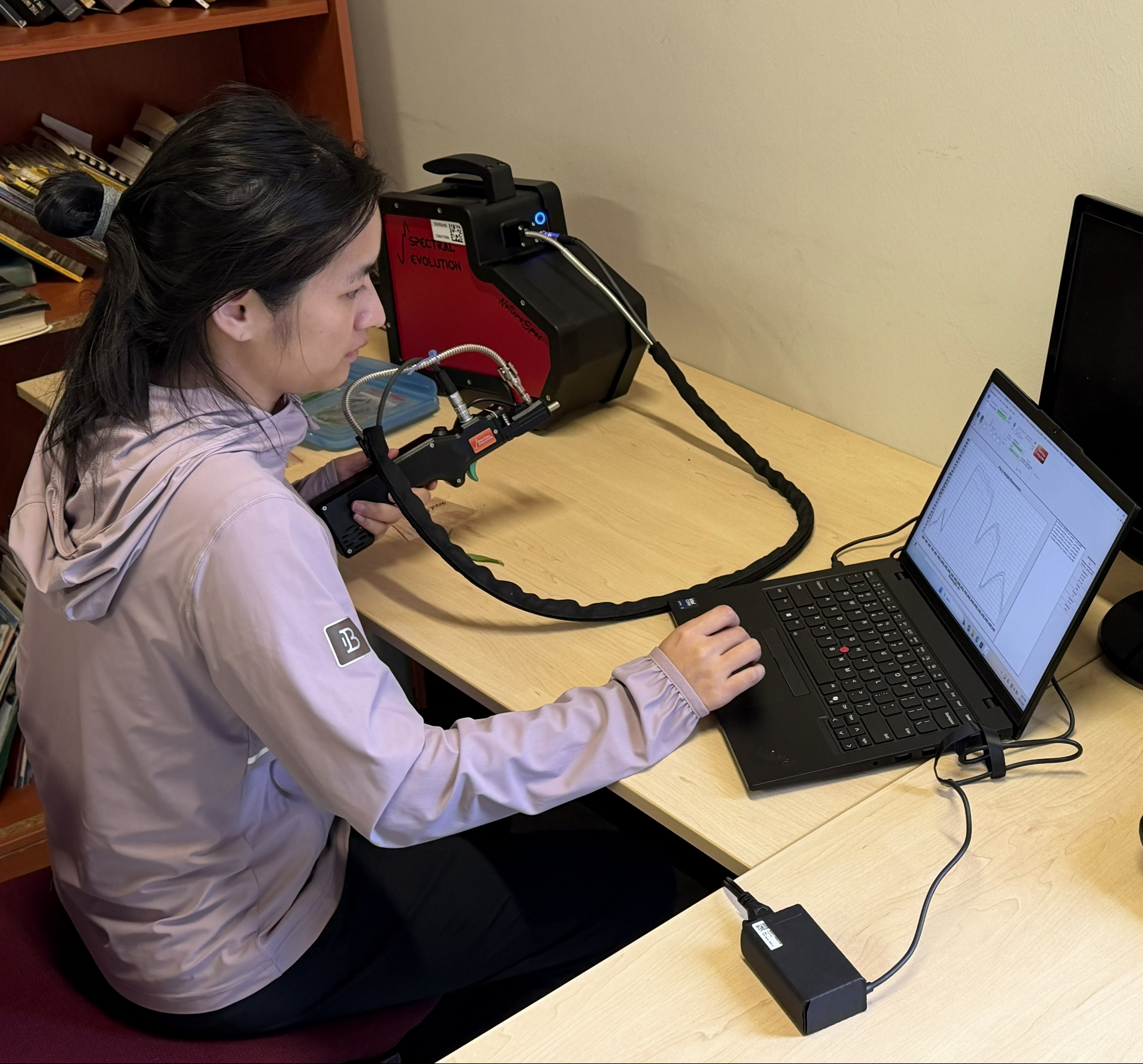
- The Qiu lab at the Nicholas School of the Environment (NSOE) at Duke University is always seeking motivated postdoc associates, graduate students, visiting scholars, and undergraduate students. We work on a extensive range of projects that span various scales from individuals to the entire globe, and different ecosystems, such as forests, savannas, and urban environments. We used ecological monitoring network (e.g., NEON, MASTIF, FIA, CFI, and build new plots), airborne data (i.e., LiDAR, hyperspectral, multispectral), advanced terrestrial laser scanning (i.e., Riegl VZ400i), Spectroradiometer (i.e., NatureSpec and airborne HySpex sensors), and satellite remote sensing (e.g., Planet-scope, EMIT, MODIS) to answer our research questions. Prospective students can visit our research projects and lab members for details. Members in the Qiu lab will have access to individual workstations, as well as designated allocations at computing clusters (A100 GPU and hundreds of CPUs). Duke University is renowned for its prestigious academic standing, consistently ranked among the top 10 universities. Its commitment to advancing ecological research is supported by extensive resources, including the Duke Marine Lab, a world-class coastal research facility, and the 7,000-acre Duke Forest, a living laboratory for studying biodiversity, climate change, and ecosystem dynamics.
- Ph.D. Student Positions (recruiting for fall 2027):
- We are looking for one talented and highly motivated Ph.D. student who are expected to work on the following broad themes:
- Ecological remote sensing for forest and savanna ecosystems. Characterize and understand the spatial and temporal variation in the structure, functioning, and dynamics of forests and savannas. Integrate emerging remote sensing technologies, including imaging spectroscopy, LiDAR, and satellite-based time series, to investigate ecosystem responses to environmental change.
- Biodiversity and ecosystem functioning. Investigate how interactions between plants and wildlife shape ecosystem processes, including carbon and nutrient cycling. Combine remote sensing, field inventories, wildlife monitoring, and statistical models to understand how fire, grazing, and wildlife reintroductions (e.g., rhinos and elephants) alter biodiversity and its contributions to ecosystem functioning.
- AI for Ecology. Develop and apply advanced AI methods, including deep learning and foundation models, to uncover ecological patterns and improve ecological predictions using large-scale Earth observation data and long-term ecological monitoring datasets.
- Quantifications: Strong quantitative and data science skills are required. Bachelor’s or master’s degree in remote sensing, ecology, engineering, environmental science, geoscience, or earth science is highly preferred. Proficiency in oral/written English is desired. Selecting an Ph.D. adviser that suits your interests is key to the success of your graduate school. Prospective students are thus encouraged to contact Dr. Tong Qiu (tong.qiu@duke.edu) to discuss potential projects before their applications. Preferred candidate should have experience with one or more of: LiDAR, hyperspectral data, statistical ecology, or machine/deep learning. Please include your CV that describes your interests and qualifications that are relevant to the lab’s research theme. Please use the subject line: application for PhD. Qualified applications will be reviewed upon receiving. The starting salary is $42,000 for Ph.D. student (plus benefits and tuition waiver)
- To apply: Application instructions for the Environment Ph.D. can be found at https://nicholas.duke.edu/academics/doctoral-programs/environment-env. The due date is Dec 1st (to be considered for departmental assistantship and university fellowships). For University Program in Ecology (UPE), instructions can be found at https://nicholas.duke.edu/academics/doctoral-programs/university-program-ecology-upe. The due date is December 1st. Apply portal and minimum requirements for both programs can be found at https://gradschool.duke.edu/admissions/application-instructions/. International students should also meet the minimum requirement of TOEFL or IELTS.
- We are looking for one talented and highly motivated Ph.D. student who are expected to work on the following broad themes:
- Postdoctoral Associate Position:
- Recruiting SCALES postdoc fellow: The Levine lab, in collaboration with the Qiu, Chaney, and Doyle groups at Duke University, is recruiting a postdoc to study the drivers and impacts of wildfire-driven forest loss in the western U.S. This position is part of the inaugural SCALES fellowship at Duke, which provides up to three years of funding, including research and professional development support. Start dates are flexible between July 1st and September 1st. The Levine lab, in collaboration with the Qiu, Chaney, and Doyle groups at Duke University, is recruiting a postdoc to study the drivers and impacts of wildfire-driven forest loss in the western U.S. This position is part of the inaugural SCALES fellowship at Duke, which provides up to three years of funding, including research and professional development support. Start dates are flexible between July 1st and September 1st. More details on how to apply below, as well as the official ad. To apply, please send (1) cover letter describing your research experience/interests, (2) a most recent CV, (3) names and contact information for three references. All of the above should be compiled into a single pdf document and sent to tong.qiu@duke.edu. Please use the subject line: application for postdoc. The starting salary is $62,000 (plus benefits and annual travel fund).
- Other opportunities: If you are interested in working on other projects, please email Dr. Tong Qiu a copy of your resume or CV and an outline of your background and interests. We will be in touch if we have a suitable project for you. Below are some additional funding resources if you want to develop your own research projects:
- NSF Postdoctoral Fellowship: Please send me your research outline and we can schedule a meeting to develop a proposal. I am committed to providing guidance, support, and constructive feedback to help your develop a strong application.
- NASA Postdoctoral Fellowship: Some research opportunities are limited to U.S. citizens only, so please pay attention to the citizenship requirements. Yoiu can select by NASA centers and research areas (e.g., Biological Sciences, Earth Science).
- Marie Curie International Research Fellowships: MSCA are part of the European Commission’s Horizon Europe program. These fellowships are designed to support researchers at all stages of their careers. I can provide necessary facilities (computing, field sites) to support your research projects. Please contact me with your research outline.
- Postdoc Fellowship in some universities and research institutes: There are some university and research insitutes (e.g., Fudan University) that provide prestigious postdoc fellowships. Please contact me if you plan to choose our lab as your host institute.
- Visiting Students:
- We also welcome visiting students who may wish to visit Duke University for extended periods of time (one year or two years) for conducting research in the Qiu lab, collborating with lab members on different projects. We will provide office space, computing facilities, field supply, and many other resources. Please email tong.qiu@duke.edu a copy of your resume or CV and your research outline.
- Undergraduate Researchers:
- We also welcome undergraduate students interested in possible research projects. Undergraduate students will work as paid research assistants/technicians. If you are interested in conducting field work, collecting data with terrestrial laser scanner (Riegl 400i), using geospatial software and/or coding, please email tong.qiu@duke.edu a copy of your resume or CV. Below are some additional funding resources:
- Deans' Summer Research fellowships: The Academic Deans of Trinity College will award the Deans' Summer Fellowships in support of undergraduate research and inquiry in the arts and sciences.
- Bass Connection: The Qiu lab will post opening positions on this page if there are opportunities through the bass connection.
- Muser: The application for fall 2024 has passed (we will post project at Muser in the next semesters as well). We also accept undergraduate through federal/duke work-study programs.
- Extramural Grant in the lab: We will also hire undergraduate researcher (normally full time in the summer) to provide funding to start, continue, or finish an independent project. Please contact Dr. Tong Qiu if you are interested in a senior thesis.
- We also welcome undergraduate students interested in possible research projects. Undergraduate students will work as paid research assistants/technicians. If you are interested in conducting field work, collecting data with terrestrial laser scanner (Riegl 400i), using geospatial software and/or coding, please email tong.qiu@duke.edu a copy of your resume or CV. Below are some additional funding resources: