Tong's invited talk at the American Geophysical Union fall meeting 2024 in Washington, D.C.
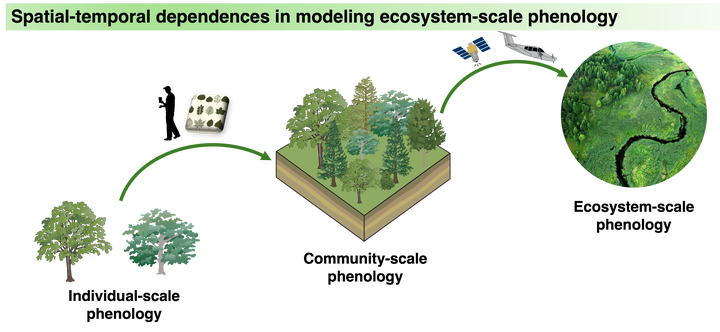
Tong’s abstract: Understanding the drivers of plant phenology, the intra-annual rhythm of the start, progression, and ending of vegetation activity, is a key goal of global change research. Previous work has primarily focused on the relationship between phenology and abiotic factors such as temperature, precipitation, and photoperiod, while largely omitting the effects of species interactions. Species interactions, where species respond to the environment while simultaneously interacting with other species that also respond to the same environment, have not been incorporated into phenological models due to the substantial investment required for field measurements on both phenology and biodiversity variables. Additionally, while global change studies have improved our understanding of temporal shifts in phenology and their environmental drivers, the effects of habitat heterogeneity and spatial correlations on phenology remain inconclusive. Our study aims to bridge these gaps by synthesizing ground observations from the National Ecological Observatory Network (NEON) and the National Phenology Network (NPN) with data from airborne and satellite remote sensing within a Bayesian hierarchical model. We found that species interactions significantly affect plant phenology, especially in less temperature-sensitive species. The effects of biodiversity depend on growth forms, seasons, geographical distributions, and native status. Incorporating habitat characteristics and spatial correlation significantly improves model fitting across broad biogeographic gradients, with the magnitude of habitat impacts being similar to that of climate variations. By bridging the scales from individual species to ecosystems, this research provides a more comprehensive understanding of the drivers of phenological change in the context of global environmental change. This integrated approach offers valuable insights for predicting vegetation responses to future climate scenarios and for developing effective conservation strategies.
Yu Wei
former Ph.D. Student
My research interest focuses on LiDAR and forestry
Hanshi Chen
Ph.D. student
My research interest focuses on remote sensing of ecology.